
Chemistry Lab
Please read the following carefully and keep this document with you at all times when in the laboratory. Your lab instructor will review these rules and regulations with you at the beginning of the lab course. It's your responsibility to understand them, as they're designed to ensure a safe laboratory environment for everyone.
These rules are in place for your own protection, and following them will help prevent accidents and injuries.
🛡️ Safety Guidelines
- Eye Protection:Wear approved safety goggles at all times in the lab. Failure to do so will result in immediate expulsion and an unexcused absence for that experiment. Eye injuries, whether chemical or mechanical, are always serious. Know the locations of the eyewash stations in the lab.
- Protective Clothing:Wear lab coats, long pants, closed shoes, and socks to cover your skin. No bare feet, open shoes, or short pants are allowed in the lab.
- First Aid: Report minor cuts or burns to your instructor or lab manager immediately. Minor first-aid treatment is available within the building.
- Serious Injury:If someone is seriously injured, don't move them. Notify your instructor immediately and stay with the person until help arrives.
- No Smoking/Eating/Drinking: These activities are not allowed in the teaching laboratories or stockroom.
⚗️ Lab Procedures
- Chemical Fumes: Be cautious when noting the odors of fumes and avoid breathing them.
- Chemical Spills & Bench Tidiness: Clean up small spills using the appropriate method. If unsure, contact your instructor or lab manager. Keep your bench tidy and use top-loading balances for NaOH and KOH.
- Running Experiments: Follow the experimental procedure exactly, unless instructed otherwise by your instructor. Know the chemicals you're working with and what to do in case of an accident or spillage.
🧯 Lab Safety & Equipment
- Lab Hours: You're only allowed to work in the lab during scheduled hours, unless given permission by your instructor. Normal lab hours are 9:00 am to 5:00 pm.
- Fire Safety: Know the location and proper use of fire extinguishers. STOP-DROP-ROLL if your clothes catch fire. Don't use a fire extinguisher on someone whose clothes are on fire.
- Safety Shower: Use the safety shower if corrosive chemicals are spilled on your body. Remove contaminated clothing and use plenty of water.
- Glassware: Dispose of broken glassware properly and get replacements from the stockroom.
- Used Chemicals: Check with your instructor or lab manager about disposing of used chemicals. Most chemicals can't be poured down the sink.
CHEMISTRY LAB - PHOTO GALLERY
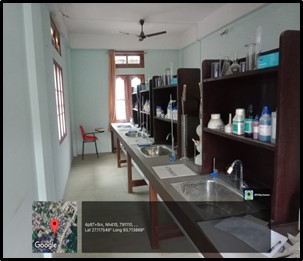
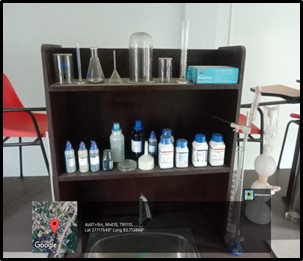
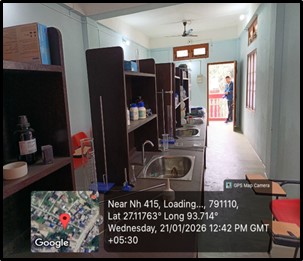
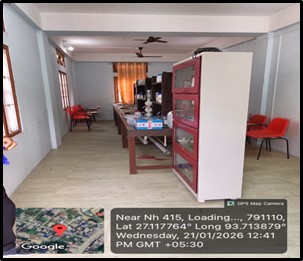
CHEMISTRY LAB – CHEMICAL & EQUIPMENT LIST
| Sr. No | Particular | Chemical Formula | Qty |
|---|---|---|---|
| 1 | Conc Hydrochloric Acid | HCL | 1L |
| 2 | Conc Sulphuric Acid | H₂SO₄ | 1L |
| 3 | Ammonia Solution | NH₄OH | 500ml |
| 4 | Acetic Acid Glacial | CH₃COOH | 500ml |
| 5 | Conc Nitric Acid | HNO₃ | 500ml |
| 6 | Hydrogen Peroxide | H₂O₂ | 500ml |
| 7 | Lead Nitrate | Pb(NO₃)₂ | 500gm |
| 8 | Ferrous Sulphate | FeSO₄ | 500gm |
| 9 | Aluminium Sulphate | Al₂(SO₄)₃ | 500gm |
| 10 | Potassium Iodide | KI | 100gm |
| 11 | Nessler Reagent | K₂HgI₄ | 125ml |
| 12 | Phenolphthalein | C₂₀H₁₄O₄ | 125ml |
| 13 | Litmus Blue Indicator | — | 125ml |
| 14 | Potassium Permanganate | KMnO₄ | 500gm |
| 15 | Ammonium Sulphate | (NH₄)₂SO₄ | 500gm |
| 16 | Manganese Sulphate | MnSO₄·H₂O | 500gm |
| 17 | Lead Acetate Trihydrate | Pb(CH₃COO)₂·3H₂O | 500gm |
| 18 | Methyl Orange | C₁₄H₁₄N₃NaO₃S | 125ml |
| 19 | Sodium Nitrate | NaNO₃ | 500gm |
| 20 | Fehling Solution A | — | 500ml |
| 21 | Sodium Hydroxide | NaOH | 500gm |
| 22 | Copper Sulphate Pentahydrate | CuSO₄·5H₂O | 500gm |
| 23 | Buffer Solution pH 9.2 | — | 500ml |
| 24 | Buffer Solution pH 7 | — | 500ml |
| 25 | Potassium Chloride | KCl | 500gm |
| 26 | Sodium Acetate Anhydrous | C₂H₃NaO₂ | 200gm |
| 27 | Benzoic Acid | C₆H₅COOH | 500gm |
| 28 | Distilled / Deionized Water | H₂O | 5L |
For Measuring & Transferring Liquids:
| Sr. No | Particular | Qty |
|---|---|---|
| 1 | Beakers: General Mixing, Heating, Holding Liquids. | 18 |
| 2 | Conical Flasks: Mixing, Heating, Titrations (Narrow Neck Prevents Splashing). | 11 |
| 3 | Volumetric Cylinders | 6 |
| 4 | Graduated Cylinders: Measuring Approximate Volumes of Liquids. | 4 Large, 6 Medium, 6 Small |
| 5 | Volumetric Flasks: Preparing Precise Solutions/Dilutions (Long Neck, Flat Bottom). | 11 |
| 6 | Pipettes (Volumetric + Graduated): Transferring Small, Precise Volumes. | 6 |
| 7 | Burettes: Highly accurate volume dispensing (for titrations) | 5 Large, 4 Small |
| 8 | Wash Bottles: Dispensing distilled water. | 4 |
| 9 | Droppers / Pasteur Pipettes: Transferring tiny liquid amounts. | - |
| 10 | Funnel (Glass): Pouring liquids, aiding filtration. | - |
| 11 | Funnel (Clay) | 5 |
| 12 | Capillary Tube | 1 pkt |
| 13 | Litmus Paper | 5 pkt |
| 14 | pH Paper | 1 pkt |
| 15 | Barometer | 1 |
For Storage & General Use:
| Sr. No | Particular | Qty |
|---|---|---|
| 1 | Reagent / Stopper Bottles: Storing chemicals. | — |
| 2 | Watch Glasses: Covering beakers, evaporating small liquid amounts, holding solids. | — |
| 3 | Glass Rods: Stirring solutions. | 30 |
| 4 | Condenser Glass | 1 |
Safety & Support:
| Sr. No | Particular | Qty |
|---|---|---|
| 1 | Safety Goggles & Gloves: Essential personal protective equipment (PPE). | 4 pkt |
| 2 | Ring Stands & Clamps: Holding glassware like burettes. | 6 |
| 3 | Test Tubes & Stands: Holding small samples/reactions. | 1 pkt |
| 4 | Bunsen Burner: Heating liquids. | 4 |